
- Home
- Products +
- About Us +
- Projects
- Application +
- News +
- Contact Us
Abrasive rock creates one of the most demanding working environments for top-hammer drilling tools. Granite, basalt, quartzite, abrasive sandstone and other silica-rich formations can rapidly wear the gauge buttons, bit body, skirt, threads and other drill-string components.
Rock abrasiveness should not be confused with rock hardness. A formation can be relatively soft but still highly abrasive if its mineral grains aggressively wear the drilling tool. Abrasive ground can therefore shorten drill-bit life regardless of its compressive strength, while hard and abrasive ground creates an especially severe combination of impact loading and wear.
For buyers, choosing the right top-hammer drilling tools is not simply a matter of selecting a bit diameter and thread. The complete decision should consider:
This guide explains how mines, quarries, tunneling contractors and drilling-tool distributors can evaluate these factors and build a more reliable top-hammer drill string for abrasive rock.
During top-hammer drilling, impact energy travels from the rock drill through the shank adapter, coupling sleeves and drill rods to the button bit. The carbide buttons repeatedly crush the rock while rotation presents a new cutting position for each impact.
In abrasive formations, hard mineral particles continuously grind against the carbide buttons and steel body. Wear is often concentrated around the gauge row because the outside buttons must maintain hole diameter while rubbing against the hole wall.
Abrasive sandstone and quartzite, for example, can produce particularly high gauge wear. As gauge buttons lose diameter, the bit may begin to bind in the hole, hole diameter can decrease, and the drill string becomes more difficult to retrieve.
Common symptoms include:
The purchasing goal should therefore be to achieve a workable balance between penetration rate, wear resistance, button toughness, hole quality and cost per meter.
A supplier cannot recommend the correct top-hammer drilling tools based only on the name of the rock. Granite from two quarries may produce very different wear because mineral composition, grain size, fractures and water conditions vary.
When laboratory rock data are unavailable, send the supplier:
A worn bit is often more informative than a general description such as “very hard granite.”
Bit-face design affects penetration, button support, flushing, hole straightness and wear distribution.
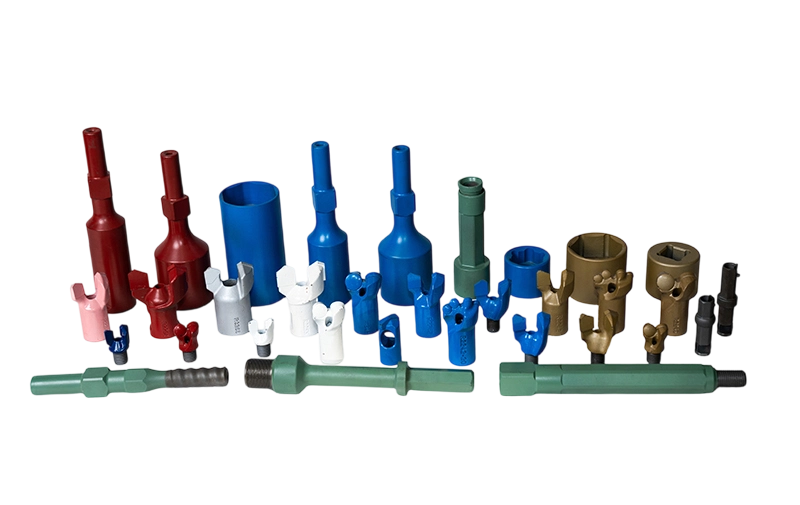
A flat-face button bit is generally a strong starting point for competent, hard and abrasive formations. Its robust front structure provides good support around the carbide buttons and distributes the cutting load across the face.
Industry selection guidance commonly recommends flat-face top-hammer bits for abrasive formations such as granite, basalt and hard limestone, as well as high-silica drilling environments.
Flat-face bits are often suitable when:
However, a flat face is not automatically the best choice when the formation is heavily fractured or the main problem is hole deviation.
Drop-center and concave designs provide additional guidance in broken or less consolidated formations. They can help stabilize the bit and improve hole straightness, although the exact design must still be checked for abrasive wear resistance.
These designs may be considered when:
For mixed ground, buyers should tell the supplier which problem is more expensive: accelerated wear or hole deviation. The recommended bit may differ depending on that priority.
Carbide profile is one of the most important decisions when purchasing top-hammer bits for abrasive rock.
Spherical buttons have a rounded, robust shape. Compared with a sharper button, they generally provide stronger carbide support and better resistance to chipping and breakage.
They are commonly preferred for:
Current top-hammer selection guidance identifies large spherical buttons as an appropriate option for tough conditions in hard and abrasive rock.
The trade-off is that spherical buttons may penetrate more slowly than aggressive ballistic profiles, especially when both are new.
Ballistic buttons have a sharper profile that concentrates impact energy over a smaller contact area. They can increase penetration in suitable rock, but their sharper shape may be more vulnerable to wear or breakage in severe formations.
Full ballistic designs are generally more appropriate for softer or less abrasive rock where the buttons can maintain their profile without breaking.
Semi-ballistic buttons provide a compromise between the penetration of a ballistic profile and the durability of a spherical profile. They may work well in moderately abrasive ground, but should be field-tested before being adopted across an entire operation.
Two drill bits can have the same diameter, thread, face and button profile but perform very differently because the cemented-carbide grades are different.
A carbide grade for abrasive rock must balance:
Harder carbide may resist wear but become more vulnerable to chipping under severe impact or fractured ground. Tougher carbide may resist breakage but wear too quickly in high-silica rock.
Advanced carbide technologies therefore use different material structures to combine a wear-resistant exterior with a tougher center or to increase wear resistance as drilling progresses. These designs aim to retain button shape, extend grinding intervals and reduce premature carbide failure.
When comparing suppliers, do not accept “high-quality tungsten carbide” as a sufficient specification. Ask:
A technically capable supplier should be able to explain why a particular carbide grade fits the application.
In abrasive drilling, gauge buttons deserve special attention because they control the hole diameter and experience contact with the hole wall.
A suitable abrasive-rock bit may include:
A standard skirt may be adequate for competent rock, shallow holes and applications where the drill string can be removed easily.
A heavy-duty skirt contains additional wear material, especially toward the front of the skirt, to protect the bit body from abrasive cuttings. This can be valuable where body wear occurs before the carbide buttons have reached the end of their useful life.
A retrac bit has splines or cutting features along the skirt. It can improve retrieval, support hole straightness and provide chipways that assist flushing.
Retrac bits are often considered for:
However, a retrac design may cost more than a regular skirt. The decision should be based on the total cost of stuck drill strings, lost tools and hole deviation—not purchase price alone.
A durable bit cannot compensate for an incorrectly matched drill string.
The thread system must transmit impact and rotation efficiently while withstanding bending, vibration and repeated coupling. Common systems include R32, T38, T45, T51 and larger proprietary or specialized connections.
Selection should consider:
Effective flushing removes cuttings before they are crushed again or trapped between the bit and the hole wall.
This is especially important in abrasive rock because retained cuttings act as additional grinding material. Poor removal can increase body wear, reduce penetration and waste impact energy on already-broken rock.
Modern top-hammer bit designs use the number, position and geometry of flushing holes and grooves to clear cuttings more rapidly.
However, more flushing is not always better. Excessive flushing volume can sandblast the bit steel, increase body wash and leave carbide buttons with insufficient steel support.
Buyers should confirm:
The goal is controlled cuttings evacuation, not simply the maximum available flow.
Even the correct drill bit can fail prematurely when drilling parameters are unsuitable.
Key parameters include:
Excessive rotation can accelerate gauge wear, especially in abrasive formations. Too little rotation can cause buttons to strike previously broken areas instead of fresh rock.
The correct setting should produce even rotation, stable penetration and a balanced wear pattern.
Insufficient feed can create poor bit-to-rock contact and increase vibration. Excessive feed can overload the drill string, reduce rotation and increase bending stress.
Maximum percussion is not always the most economical setting. When bit wear, vibration or poor flushing increases, reducing percussion and optimizing the other parameters may produce a lower cost per meter.
Many bit and rod failures begin during collaring. Start with controlled impact, rotation and feed until the bit has established a stable hole. Full drilling power can then be applied according to the machine manufacturer’s recommendations.
The correct operating window should be determined through field testing rather than copied from a different quarry or mine.
Regrinding is essential for conventional carbide-button bits in abrasive rock.
As buttons develop wear flats, less impact energy is used to fracture fresh rock. Penetration falls, heat and vibration increase, and more stress returns through the drill string.
A widely used maintenance rule is to regrind before the wear flat exceeds approximately one-third of the button diameter. The exact limit may vary by profile and supplier, but waiting until the buttons are severely flat increases the amount of carbide that must be removed and raises the risk of cracks or breakage.
A practical program should record:
Wet grinding can help limit heat-related carbide damage, and grinding cups should match the original button profile.
Do not grind only when the operator feels that the bit has become slow. A planned interval based on actual wear data is more consistent.
A lower-priced drill bit may become the more expensive option if it requires frequent changes, loses gauge quickly or reduces penetration.
A basic cost-per-meter calculation is:
Tool Cost per Meter = Total Consumable Tool Cost ÷ Total Acceptable Meters Drilled
A more complete calculation should include:
For example, Bit A may cost 20% more than Bit B but drill 45% more meters, require fewer changes and maintain a higher penetration rate. In that case, Bit A may deliver a significantly lower operating cost.
Do not compare two bits in unrelated drilling conditions. A proper trial should control as many variables as possible.
Use:
Record results for several bits, not just one. A single bit can be affected by an unusual fracture, operator error or manufacturing variation.
Before placing a bulk order, ask the supplier to confirm:
Hardness does not fully describe abrasiveness. Silica content, grain size and cuttings behavior also influence wear.
A ballistic bit may drill quickly at the beginning but lose its sharp profile or break prematurely in severe abrasive conditions.
The face buttons may still look usable while the gauge diameter has already fallen below an acceptable level.
Insufficient flushing causes recutting, but excessive flushing can erode the steel body. The flow must match the hole and cuttings.
Overdrilling reduces penetration and increases the risk of button damage, gauge loss and stress on the complete drill string.
Tool price is only one component of drilling cost. Productivity, service life, maintenance and downtime must also be measured.
Spherical buttons are a reliable starting choice because of their robust shape and resistance to impact damage. However, semi-ballistic or specialized profiles may provide a better penetration-life balance in moderately abrasive formations. A controlled field trial is still necessary.
A flat face is commonly selected for competent abrasive rock. In fractured ground, a drop-center, concave or short-retrac design may provide better guidance. The supplier may need to combine an abrasive-resistant cutting structure with a hole-straightness feature.
The interval depends on wear rate, button profile and drilling parameters. Inspect bits frequently and regrind before wear flats become excessive. Approximately one-third of the button diameter is a commonly used upper limit for conventional top-hammer buttons.
Gauge buttons maintain hole diameter and remain in contact with the hole wall. Abrasive minerals and excessive rotation can therefore concentrate wear around the outside of the bit.
A heavy-duty body can provide additional wear material, but weight alone does not guarantee better performance. Carbide grade, button support, face geometry, flushing and compatibility with the rock drill are equally important.
Choosing top-hammer drilling tools for abrasive rock requires a system-based approach. Start by understanding the formation, then select an appropriate bit face, durable carbide profile, application-specific carbide grade and reinforced gauge structure. Match the bit with the correct rods, couplings and shank adapter, and verify that the flushing system can remove cuttings without causing excessive body wash.
The final decision should be based on field data—especially penetration rate, meters between regrinds, total meters per bit, hole diameter retention and cost per meter.
Before requesting a quotation, provide your supplier with the rock type, hole diameter, drilling depth, thread system, rock-drill model, flushing method, current tool specification and photos of worn bits. This information makes it possible to recommend top-hammer drilling tools that deliver a more reliable balance of penetration, service life and operating cost.

We are dedicated to building a better future with you through meticulous and professional service!